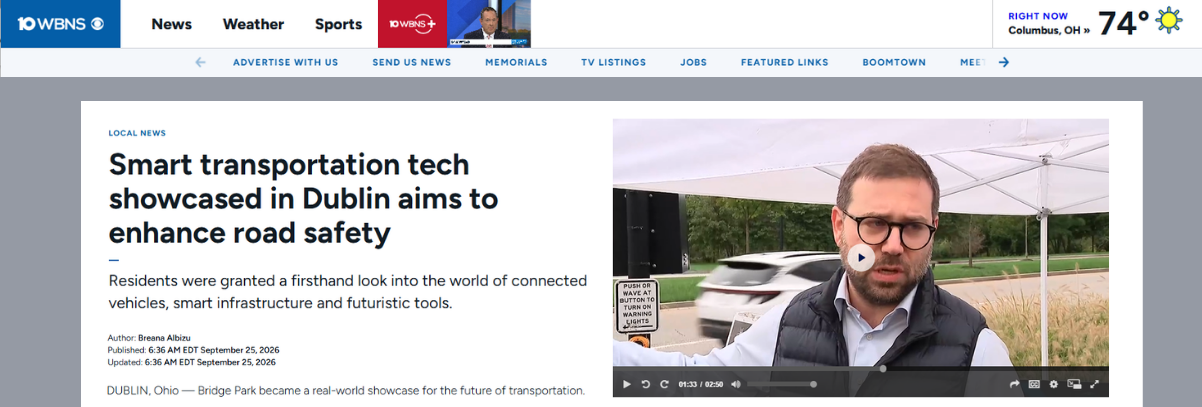
Smart transportation tech showcased in Dublin aims to enhance road safety
September 25, 2026 — 10 WBNS — Bridge Park in Dublin, Ohio became a real-world showcase for the future of transportation.
This week, transportation leaders and technology experts gathered for the annual ITS Midwest Conference & Expo. It's an opportunity for those in the heart of the community to bring emerging technology and issue live demonstrations. Officials from the City of Dublin hosted the event this year.
"This is an up-and-coming area. They're on the forefront," said Nick Hegemier, managing director of infrastructure with Drive Ohio.
By Breana Albizu
Residents were granted a firsthand look into the world of connected vehicles, smart infrastructure and futuristic tools.
DUBLIN, Ohio — Bridge Park became a real-world showcase for the future of transportation.
This week, transportation leaders and technology experts gathered for the annual ITS Midwest Conference & Expo. It's an opportunity for those in the heart of the community to bring emerging technology and issue live demonstrations. Officials from the City of Dublin hosted the event this year.
"This is an up-and-coming area. They're on the forefront," said Nick Hegemier, managing director of infrastructure with Drive Ohio.
During the conference, visitors and residents were also granted a firsthand look into the world of connected vehicles, smart infrastructure, and futuristic tools, all in an effort to make transportation safer and smarter for drivers and pedestrians.
"The most interesting part is bringing all of the vendors together and having them be interoperable," said Hegemier.
The event included a ride-along through one of the city's most popular areas, Bridge Park. By using a special device from the company, Ettifos, participants could see how cars and roadway infrastructure "talk" to each other in real time. From alerts like speech checks and pothole detection to crosswalk illumination.
"There could be potholes. Maybe the drivers can't see, so this is another type of warning that could be helpful for the safety of drivers," said Jane Lee. She leads Global Business Development at Ettifos.
The device even offers a full countdown to traffic lights before they change colors.
"You can then know, okay, maybe I should slow down. I can see, for example, if there's only five seconds left for green," added Lee. "I shouldn't just try to step on it and go through."
The emerging technology is just one of several promoting efficiency out on the roads.
Another visualization at the Riverside Drive roundabout showed how artificial intelligence could predict where vehicles were headed, how to keep pedestrians unharmed and decrease crashes.
The roundabout combines two state routes, which in turn, equals a lot of traffic.
"We see a few crashes a month, even a week, at this roundabout," said Karl Jeanbart, COO & co-Founder at Derq.
The system, called Derq, uses real-time data to help better understand traffic flows and driver interactions around the circle.
It also keeps vehicles anonymous and never personally identifies them.
"This is kind of the AI layer that is translating what the cameras and other sensors are seeing," Jeanbart said.
This is just one of several initiatives that leaders around central Ohio are paying extra attention to.
While some of the showcased technology is already installed in areas like Dublin and Marysville, other cities are hoping to install their own devices within the next four years.
Why Intersections Need a Safety Layer Inspired by Aviation
September 8, 2026 — Intertraffic — Intersections remain among the most predictable points of risk in road networks, bringing together vehicles, pedestrians and cyclists in environments with competing movements and limited visibility. Georges Aoude, co-founder and CEO of Derq, argues that road transport can learn from aviation, where shared awareness and structured communication help identify and resolve risks before they lead to accidents.
Most traffic infrastructure can control movement but cannot fully understand what is happening around it.
Tuesday, September 8, 2026
Intersections remain among the most predictable points of risk in road networks, bringing together vehicles, pedestrians and cyclists in environments with competing movements and limited visibility. Georges Aoude, co-founder and CEO of Derq, argues that road transport can learn from aviation, where shared awareness and structured communication help identify and resolve risks before they lead to accidents.
Most traffic infrastructure can control movement but cannot fully understand what is happening around it. A traffic signal may know its current state, for example, but not whether a vehicle is unlikely to stop, a pedestrian is entering a potential conflict, or repeated near misses are revealing a wider safety risk.
Aoude believes intelligence therefore needs to become part of the intersection itself. Using sensors, edge AI and AI-powered ITS, infrastructure can detect road users in real time, interpret their movements and identify potentially dangerous situations before a collision occurs. Detection, prediction, alerts and action can form a continuous safety loop, with V2X providing an additional communication layer where relevant.
The technology to create these intelligent intersections already exists. The next step, Aoude argues, is to treat it as core infrastructure rather than as a pilot or operational add-on, creating road environments with greater visibility, shared awareness and earlier warnings of potential danger.
For the full article, visit ITS International.
Intersections need safety layer that aviation built decades ago
August 18, 2026 — ITS International — Intersections remain one of the most predictable points of risk in our transportation networks. Road safety has long focused on better vehicles, stronger enforcement, clearer signage, and more public awareness. All of that matters. But it still leaves too much responsibility on individual road users to detect conflict, interpret intent, and react in time.
Aviation took a different path. Aircraft don’t operate in isolation. Safety in the air depends on structured communication, shared awareness, and infrastructure that identifies and resolves risks before they become disasters.
By Georges Aoude
Derq's Georges Aoude suggests the road transportation industry can learn by looking to the skies
Intersections remain one of the most predictable points of risk in our transportation networks. Road safety has long focused on better vehicles, stronger enforcement, clearer signage, and more public awareness. All of that matters. But it still leaves too much responsibility on individual road users to detect conflict, interpret intent, and react in time.
Aviation took a different path. Aircraft don’t operate in isolation. Safety in the air depends on structured communication, shared awareness, and infrastructure that identifies and resolves risks before they become disasters. Pilots are highly trained, but aviation safety wasn’t built by assuming perfect human judgment in every moment. It was built by creating a system that reduces uncertainty and supports better real-time decisions. Aviation relies on mandatory communication and shared system design.
Roads largely don’t, so that gap is especially clear at intersections, which concentrate the conditions that make road safety difficult: competing movements, limited visibility, changing signals, pedestrian crossings, cyclist interactions, and unpredictability. These are everyday scenarios, not edge cases.
Conflict and understanding
Today, most traffic infrastructure can control movement, but it can’t truly understand it. It may know the signal state, but not whether a vehicle is unlikely to stop, whether a pedestrian is entering conflict, or whether a near-miss pattern is emerging that signals deeper risk. In most cases, agencies learn where the danger is only after crashes accumulate.
“Safer systems don’t depend on isolated actors making
perfect decisions with incomplete information”
In aerospace, the goal isn’t simply to respond once something goes wrong. It’s to maintain a shared, real-time picture of the environment so conflicts can be detected early and addressed before they escalate. Aircraft continuously share position and movement, and ground systems help create a common operating picture. That shared awareness helps humans and automated systems spot and resolve conflicts before paths intersect. Roads need their own version of that shared safety layer.
That doesn’t mean treating streets exactly like airspace. Roads are messier, more open, and more variable. But the principle still applies: safer systems don’t depend on isolated actors making perfect decisions with incomplete information.
Risk and movement
At intersections, intelligence needs to live in the infrastructure itself. An intelligent intersection can detect road users in real time, interpret movement and identify elevated-risk situations before a crash occurs. Sensors and edge AI can help infrastructure move beyond passive control—seeing conflict patterns, detecting dangerous approaches, and enabling earlier warnings or interventions. Detection, prediction, alert, and action can work as a continuous loop, supported by AI-powered ITS and V2X, where relevant.
This matters because the next step in road safety won’t come from asking more of road users. It’ll come from building environments that provide greater visibility, richer context, and earlier warning signs of danger.
The tools already exist. What’s still missing is the willingness to treat intelligent intersections as infrastructure rather than pilots or operational add-ons.
If aviation teaches us anything, it’s that safety improves when communication is structured, awareness is shared, and the system itself is designed to anticipate conflict. Roads, especially at intersections, still ask too much of individual perception alone.
We should keep improving vehicles. We should keep enforcing laws and educating road users. But if we want a meaningful step change in safety, we need infrastructure that does more than manage movement. We need infrastructure that helps prevent harm.
Intersections don’t have to remain places where visibility is partial, and prevention comes too late. We can make them more intelligent, more responsive, and far safer—today.
Derq, Toronto-based Tacel deploy AI systems at 100 Montreal intersections
June 23, 2026 — TechNX — Navigating the streets in Montreal traffic can be challenging at the best of times but the city is installing new technology from Toronto-based Tacel at 100 intersections.
It has contracted with Ann Arbor, Mich.-based Derq and its Canadian partner, Tacel, to launch the program that will provide access to real-time traffic data.
“Montreal is shifting from retrospective, historical traffic analysis toward proactive, real-time safety monitoring," Yassine Benamghar, vice-president with Tacel said to TechNX in an email exchange.
By John Dujay, Editor, New Publications
Navigating the streets in Montreal traffic can be challenging at the best of times but the city is installing new technology from Toronto-based Tacel at 100 intersections.
It has contracted with Ann Arbor, Mich.-based Derq and its Canadian partner, Tacel, to launch the program that will provide access to real-time traffic data.
“Montreal is shifting from retrospective, historical traffic analysis toward proactive, real-time safety monitoring," Yassine Benamghar, vice-president with Tacel said to TechNX in an email exchange. "The city wants to anticipate risks before they cause collisions, respond faster when emerging dangers appear, and target safety interventions where they’ll have the greatest impact for all road users: drivers, cyclists and pedestrians.”
“The deployment is part of the city’s SASMI (Safety and Mobility Analysis System at Intersections) program, and at 100 intersections it represents one of the largest AI-powered traffic safety deployments in North America.”
How AI fits in
AI is at the heart of the technology, explained Karl Jeanbart, co-founder and COO at Derq, who also spoke to TechNX through email.
So how does it work? “Computer vision lets existing traffic cameras identify and categorize different road users, including more nuanced distinctions such as cyclists versus pedestrians, and to do so across complex roadway conditions, including low-light and bad weather,” he said.
As well, it uses “behavioural analysis” to help “detect risky patterns, near-miss incidents, illegal turns, wrong-way driving, red-light running, and other safety events that might otherwise go unnoticed.”
It also provides interactive AI agents so that traffic staff members can ask questions like, where are the most near-misses during a given time period?
“For example, if a vehicle passes very close to a cyclist but no collision occurs, traditional crash reporting wouldn’t capture that event. Derq’s AI can flag it as a high-risk near-miss and help transportation teams understand the contributing factors, enabling them to take action before a serious crash occurs,” Jeanbart said.
“This gives municipalities a much more complete picture of how intersections are actually functioning day-to-day.”
Other communities have installed the system, according to Jeanbart.
“Derq’s technology is already field-tested and deployed across North America in communities including Detroit, Seattle, Houston, Fremont, Sarasota, and Bellevue, as well as with state transportation agencies. Transportation teams are responding to the ability to see leading indicators of risk, not just historical crash data, and to use that information to support Vision Zero, traffic operations and roadway safety planning,” he said.
Will tap into "existing infrastructure"
Montreal is deploying the system, known as INSIGHT at a cost of $1.9 million. INSIGHT “connects directly to cameras and sensors already installed at Montreal intersections, so there was no need to rip out and replace existing infrastructure, which is a significant advantage for a city with an established network,” Benamghar said.
The partnership was first announced in September 2025. The SASMI program was publicly announced on June 1, and approximately 30 intersections had been hooked up by that date.
Tacel is a Canadian-owned company that was founded in 1979. It provides a number of products for municipalities to manage traffic, such as pedestrian signals, advanced monitoring systems, signal controllers and traffic management software.
“The system feeds into CGMU’s (Centre de gestion de la mobilité urbaine) operations, and as Tacel’s role as the Canadian delivery and integration partner, we supported deployment to ensure the solution fits within the city’s existing traffic management environment,” Benamghar said.
The systems will be managed entirely in-house by CGMU, he added.
Because the system deploys real-time cameras, privacy is a concern. However, the implementation assures that these concerns are mitigated, according to Benamghar.
“This is a fair question, and one agencies ask us about regularly. The system leverages cameras and sensors Montreal already owned and operated; it doesn’t introduce a new surveillance layer, it adds an analytics layer to existing infrastructure.”
As well, the city maintains “full governance” over the program, and “is designed to analyze traffic patterns and safety conditions, not to identify individuals. It looks for risk events, not people,” he said.
The data is secure as Derq is “SOC 2 Type II certified, the recognized standard for responsible data handling,” Benamghar said.
The future of traffic management?
For now, the system is one of the largest to date in North America, Benamghar said and Tacel is hoping to expand upon the technology, and deploy to many more places.
“We want to see deployments like Montreal’s become the norm across Canada: AI-powered, proactive road safety systems operating in every major city, managed by municipalities themselves and grounded in the data they already collect.”
“Ultimately, we’re working toward a Vision Zero future. where no loss of life on our roads is considered acceptable,” Benamghar said.
Derq and AT&T Collaborate to Advance AI-Powered Transportation Infrastructure
June 9, 2026 — Detroit, MI — Derq, the intelligent transportation company enabling cities to prevent fatalities using proven, real-world AI at intersections, today announced it is collaborating with AT&T to accelerate the deployment of real-time safety and traffic intelligence across connected transportation ecosystems.
The agreement expands the relationship from initial investment to commercial collaboration, building on AT&T’s strategic investment in Derq in late 2024. Under the agreement, the companies will work together to integrate Derq’s transportation intelligence into AT&T’s Intelligent Transportation Platform (ITP) solution for cities and agencies.
This work builds on AT&T’s 2024 strategic investment to advance safer, smarter connected vehicle infrastructure.
June 9, 2026 — Detroit, MI — Derq, the intelligent transportation company enabling cities to prevent fatalities using proven, real-world AI at intersections, today announced it is collaborating with AT&T to accelerate the deployment of real-time safety and traffic intelligence across connected transportation ecosystems.
The agreement expands the relationship from initial investment to commercial collaboration, building on AT&T’s strategic investment in Derq in late 2024. Under the agreement, the companies will work together to integrate Derq’s transportation intelligence into AT&T’s Intelligent Transportation Platform (ITP) solution for cities and agencies.
Cutting-Edge Safety Intelligence Becomes Part of Transportation Infrastructure
Derq’s AI platform will serve as a key data input into AT&T’s ITP, supporting more responsive, connected, and safety-focused mobility systems.
Derq’s platform provides detection and analysis of critical roadway events as they happen, including:
Collisions and wrong-way driving
Close calls and safety hotspots
Road hazards — including animals, debris, fire, and low visibility conditions
Speed, congestion, and traffic pattern insights
These continuous insights and alerts feed into AT&T’s ITP to support traffic management centers, emergency response coordination, and connected vehicle applications.
“Transportation agencies need intelligent ways to connect infrastructure at the edge while supporting cloud-based, scalable data lakes, AI/ML pipelines for predictive decision-making, and insights across increasingly complex mobility environments,” said Usman Zafar, AVP Emerging Solutions at AT&T. “Our ITP is designed to support that transformation, and Derq’s safety intelligence adds an important layer of roadway insight that enables AT&T's Intelligent traffic management and advanced connected transportation use cases at scale.”
Scaling Deployment Through AT&T’s Infrastructure and Public Sector Reach
“This collaboration marks an important step in scaling the impact of our industry-leading analytics and V2X applications,” said Dr. Georges Aoude, Co-Founder and CEO of Derq. “Together with AT&T, we’re bringing safety intelligence into the infrastructure that cities rely on to manage traffic, reduce risk, and protect all road users at scale.”
Derq’s safety intelligence will complement AT&T’s Transportation solutions, alongside its connectivity, data, and network capabilities, as part of a broader transportation platform designed to support safer, more connected mobility across urban and highway environments. This creates a pathway to bring Derq’s AI-powered safety insights into connected transportation systems that support traffic operations, public safety, and future V2X and V2N applications.
As Cities Seek More Proactive Safety Tools, Advanced Intelligence Gains Importance
While many solutions in the market today focus on analyzing historical data and streamlining workflows, Derq’s platform is designed to identify and surface risks, fueling earlier intervention and more proactive traffic and safety management.
Connect with Derq at ITS America 2026
Derq will participate in this year’s ITS America Conference & Expo in Detroit, where Derq Co-founder and COO Karl Jeanbart will join AT&T and other transportation technology leaders for the session, “Building Future-Ready Digital Infrastructure Through Connectivity and Real-Time Insights,” on Thursday, June 11, from 1:00–2:00 p.m. ET in Room 310B. Derq will also exhibit at booth #2030.
For more information, visit https://en.derq.com/.
About Derq
Derq is an AI-powered intelligent transportation company helping cities and agencies prevent crashes, solve complex road safety challenges, and improve traffic flow. An MIT spinoff founded in 2016, Derq's award-winning technology is deployed across more than 40 agencies across the U.S., Canada, and the GCC region, with 18 patents and global recognition from leaders in AI and mobility. Visit https://en.derq.com/ to learn more.
Media Contact:
Flight PR
Alysha Light
media@derq.com
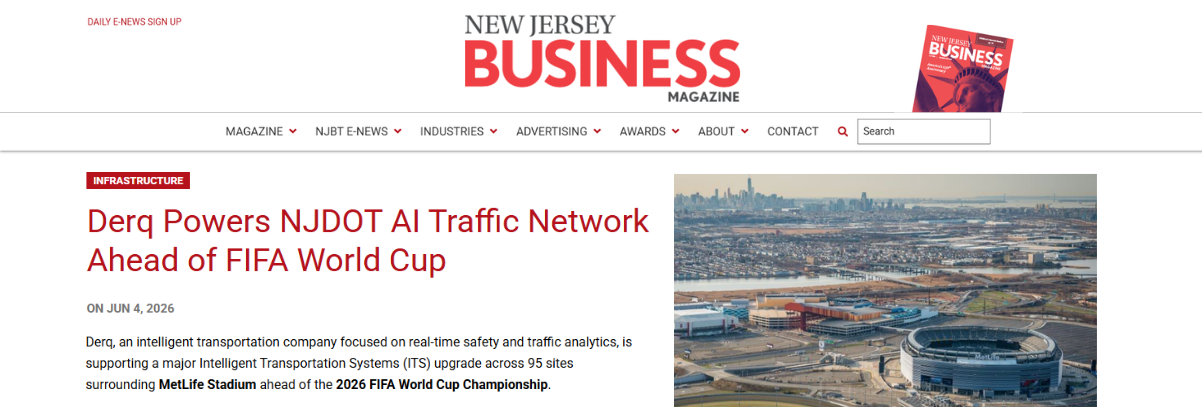
Derq Powers NJDOT AI Traffic Network Ahead of FIFA World Cup
June 4, 2026 — New Jersey Business — Derq, an intelligent transportation company focused on real-time safety and traffic analytics, is supporting a major Intelligent Transportation Systems (ITS) upgrade across 95 sites surrounding MetLife Stadium ahead of the 2026 FIFA World Cup Championship.
The project is part of a broader effort led by the New Jersey Department of Transportation (NJDOT) to prepare critical roadway infrastructure for a significant increase in traffic during the tournament, with more than 1 million visitors expected across the New York–New Jersey region.
Derq, an intelligent transportation company focused on real-time safety and traffic analytics, is supporting a major Intelligent Transportation Systems (ITS) upgrade across 95 sites surrounding MetLife Stadium ahead of the 2026 FIFA World Cup Championship.
The project is part of a broader effort led by the New Jersey Department of Transportation (NJDOT) to prepare critical roadway infrastructure for a significant increase in traffic during the tournament, with more than 1 million visitors expected across the New York–New Jersey region.
The deployment spans highways and surface streets throughout the Meadowlands area, where a mix of complex roadway infrastructure and event-driven congestion presents unique operational challenges.
Derq’s AI-powered analytics platform is being used to process real-time data from roadway cameras and monitor key conditions, including:
Crash detection
Wrong-way driving
Pedestrian and right-of-way intrusions
Fire detection
Animal detection
Vehicle and pedestrian counts, and traffic patterns
The data feeds into NJDOT’s Advanced Traffic Management System (ATMS), helping transportation teams monitor conditions and manage traffic during high-volume events.
Michael Baker International specified the project and led a comprehensive ITS needs assessment, earning a Transportation Achievement Award from the Institute of Transportation Engineers (ITE) for its work.
Engineering firm HNTB is leading implementation, with Derq providing analytics and monitoring capabilities within the broader system, alongside regional partner SCP Signal Control Products.
As cities prepare for large-scale events like the World Cup, transportation agencies are placing greater emphasis on real-time visibility into roadway conditions.
“This project marks an important opportunity to apply our technology in one of the most complex and high-visibility transportation environments tied to the biggest sporting event in the world,” said Dr. Georges Aoude, co-founder and CEO of Derq. “By delivering continuous insights and real-time alerts, we enable transportation agencies to better anticipate risks, adapt to changing conditions, and operate more proactively.”
While the system is being deployed ahead of the World Cup, the infrastructure is expected to support ongoing traffic operations across the region, improving visibility into roadway conditions during future events and everyday travel.
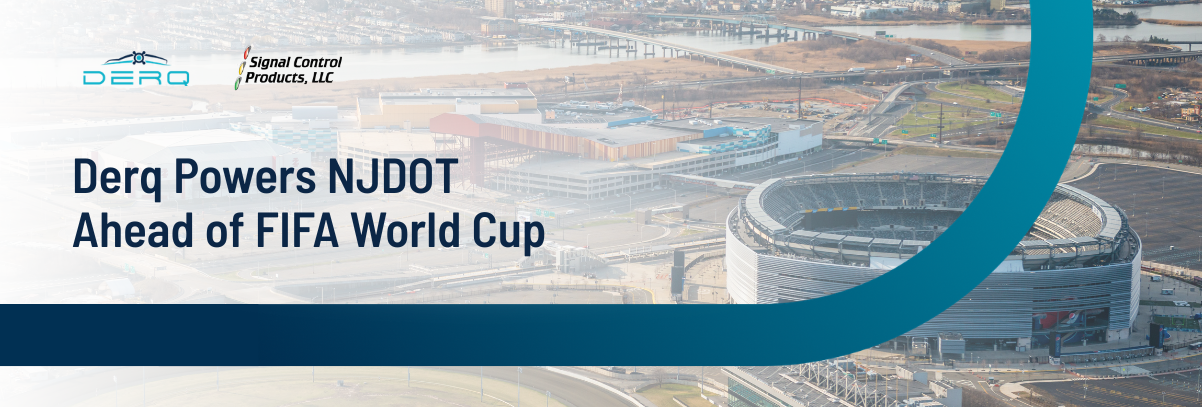
Derq Powers NJDOT AI Traffic Network Across Nearly 100 Sites Ahead of FIFA World Cup
June 3, 2026 — Detroit, MI — Derq, an intelligent transportation company focused on real-time safety and traffic analytics, is supporting a major Intelligent Transportation Systems (ITS) upgrade across 95 sites surrounding MetLife Stadium ahead of the 2026 FIFA World Cup.
The project is part of a broader effort led by the New Jersey Department of Transportation (NJDOT) to prepare critical roadway infrastructure for a significant increase in traffic during the tournament, with more than 1 million visitors expected across the New York–New Jersey region.
Large-scale deployment near MetLife Stadium reflects broader infrastructure push ahead of high-volume global events.
June 3, 2026 — Detroit, MI — Derq, an intelligent transportation company focused on real-time safety and traffic analytics, is supporting a major Intelligent Transportation Systems (ITS) upgrade across 95 sites surrounding MetLife Stadium ahead of the 2026 FIFA World Cup Championship.
The project is part of a broader effort led by the New Jersey Department of Transportation (NJDOT) to prepare critical roadway infrastructure for a significant increase in traffic during the tournament, with more than 1 million visitors expected across the New York–New Jersey region.
New Jersey Expands Traffic Monitoring Across Key Corridors
The deployment spans highways and surface streets throughout the Meadowlands area, where a mix of complex roadway infrastructure and event-driven congestion presents unique operational challenges.
Derq’s AI-powered analytics platform is being used to process real-time data from roadway cameras and monitor key conditions, including:
Crash detection
Wrong-way driving
Pedestrian and right-of-way intrusions
Fire detection
Animal detection
Vehicle and pedestrian counts, and traffic patterns
The data feeds into NJDOT’s Advanced Traffic Management System (ATMS), helping transportation teams monitor conditions and manage traffic during high-volume events.
Award-Winning Planning Effort Informs Deployment
Michael Baker International specified the project and led a comprehensive ITS needs assessment, earning a Transportation Achievement Award from the Institute of Transportation Engineers (ITE) for its work.
Engineering firm HNTB is leading implementation, with Derq providing analytics and monitoring capabilities within the broader system, alongside regional partner SCP Signal Control Products.
Cities Look to Real-Time Data Ahead of Major Events
As cities prepare for large-scale events like the World Cup, transportation agencies are placing greater emphasis on real-time visibility into roadway conditions.
“This project marks an important opportunity to apply our technology in one of the most complex and high-visibility transportation environments tied to the biggest sporting event in the world,” said Dr. Georges Aoude, Co-Founder and CEO of Derq. “By delivering continuous insights and real-time alerts, we enable transportation agencies to better anticipate risks, adapt to changing conditions, and operate more proactively.”
Upgrades Expected to Extend Beyond the Tournament
While the system is being deployed ahead of the World Cup, the infrastructure is expected to support ongoing traffic operations across the region, improving visibility into roadway conditions during future events and everyday travel.
For more information, visit https://en.derq.com/.
About Derq
Derq is an AI-powered intelligent transportation company helping cities and agencies prevent crashes, solve complex road safety challenges, and improve traffic flow. An MIT spinoff founded in 2016, Derq's award-winning technology is deployed across more than 40 agencies across the U.S., Canada, and the GCC region, with 18 patents and global recognition from leaders in AI and mobility. Visit https://en.derq.com/ to learn more.
Media Contact:
Flight PR
Alysha Light
media@derq.com
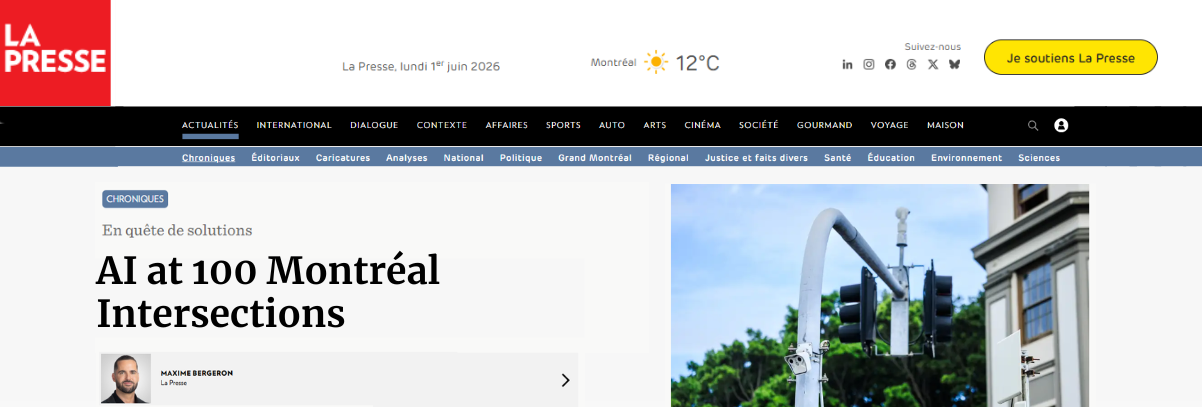
AI at 100 Montreal Intersections
June 1, 2026 — La Presse — Disorganized construction sites and streets overrun by orange cones? It’s a familiar refrain in Montreal.
This next verse, however, is more surprising: the city's main arteries are also packed with technology. More than 700 cameras monitor traffic at all times. Hundreds of sensors and counters are scattered across intersections. Traffic lights can be controlled remotely. The list goes on. This high-tech armada places Montreal in the global vanguard of so-called "smart cities."
Yet, the general impression on the streets is often chaotic. Retro, even. Just think of police officers being paid overtime to manage traffic by manually pressing a button...
By Maxime Bergeron, La Presse
Disorganized construction sites and streets overrun by orange cones? It’s a familiar refrain in Montreal.
This next verse, however, is more surprising: the city's main arteries are also packed with technology. More than 700 cameras monitor traffic at all times. Hundreds of sensors and counters are scattered across intersections. Traffic lights can be controlled remotely. The list goes on. This high-tech armada places Montreal in the global vanguard of so-called "smart cities."
Yet, the general impression on the streets is often chaotic. Retro, even. Just think of police officers being paid overtime to manage traffic by manually pressing a button...
How can we make better use of all these electronic gadgets? The City of Montreal thinks it has (finally) found a solution: artificial intelligence (AI).
The Martinez Ferrada administration will announce this Monday the installation of AI-based systems at 100 of the city's intersections by the end of the year. This marks the continuation of a project initiated at the end of Valérie Plante's administration.
Lessons from Australia
I learned this news upon returning from Australia, where I went to observe urban innovations in Melbourne and Sydney.
Both cities have successfully reduced congestion, improved safety for vulnerable road users, and achieved efficiency gains without breaking the bank. (You can read my findings in a series of reports published in La Presse).
How did they successfully make this shift?
First: By leveraging the resources they already possessed—like their networks of sensors and cameras.
The Missing Link: These devices were collecting data on the passage of cars, pedestrians, cyclists, trams, and so on. But they lacked a framework to make sense of this mountain of information.
That is where AI came in to change the game. The technology analyzes millions of movements across the road network in real time. As it "learns," the AI detects patterns. It can then propose better traffic light sequencing or more efficient detours around construction sites.
While all of this is recent, the Australian results are promising.
The Montreal Plan
Montreal hopes to achieve similar gains. The City has awarded a $2.5 million contract to the Quebec firm Tacel, which distributes technology from the American company DERQ.
To put it simply, the group will install small control boxes on traffic lights. These will connect existing cameras to an AI-powered system. This mechanism is already in use in several cities, including Detroit and Dubai.
Montreal has primarily paid for software licenses covering a 10-year period. There will be no outsourcing: the technology will be managed internally by employees at the Urban Mobility Management Center (Centre de gestion de la mobilité urbaine or CGMU).
The AI system has been quietly deployed at around thirty Montreal intersections over recent months. The City is aiming for one hundred by the end of 2026. This would make it one of the largest networks of its kind in North America.
Healthy Skepticism and Privacy Concerns
The potential of this initiative is as high as the disappointments of the past.
Between the purchase of 100 "smart" cameras under Gérald Tremblay, the creation of a "Smart City Office" under Denis Coderre, and the launch of a "Mobility Squad" under Valérie Plante, Montrealers have been promised a mobility revolution far too often. They have every right to be skeptical...
Privacy concerns will also arise. Millions of images captured on Montreal streets, analyzed by American software? The City will need to demonstrate that it has put up all the necessary safeguards.
"We do not depend on any foreign supplier. Our data stays with us. It goes into our servers, in one of our buildings downtown," Alexandre Teodoresco, the executive committee member responsible for optimization, municipal performance, and innovation, told me in an interview.
Looking Ahead: A "Digital Twin"
Despite legitimate fears, Montreal intends to move further and faster in adopting new technologies—with AI leading the charge.
The mayor has committed to creating a "digital twin" of the metropolis, similar to those that exist in Singapore, Rotterdam, Sydney, and many other cities. Essentially, this involves creating a digital replica of the city to run various simulations—for example, mapping the impact of a specific construction site on traffic congestion. The more precise data it is fed, the more useful this digital twin will prove to be.
The Martinez Ferrada administration also wants to transform downtown into an experimental zone—a sort of living lab. The idea is to bring local tech SMEs and the university research sector together to find better ways to plan construction projects.
The "brains" of an entire ecosystem will thus be put to work. This bodes quite well, as Montreal is certainly not lacking in that department.
Montréal Deploys Derq INSIGHT Across 100 Intersections in Citywide AI-Powered Safety and Traffic Data Initiative
June 1, 2026 — Montréal, Canada — The City of Montréal is deploying Derq’s AI-powered INSIGHT as part of its citywide Safety and Mobility Analysis System at Intersections (SASMI), enabling the city to proactively monitor roadway safety, identify risk patterns, and improve traffic flow across its large multimodal network. The deployment is being delivered in partnership with Tacel Ltd., Derq’s Canadian distribution partner.
As part of this deployment, Montréal is rolling out Derq INSIGHT across 100 intersections—one of the largest North American deployments to date.
June 1, 2026 — MONTRÉAL, Canada — The City of Montréal is deploying Derq’s AI-powered INSIGHT as part of its citywide Safety and Mobility Analysis System at Intersections (SASMI), enabling the city’s transportation teams to proactively monitor roadway safety, identify risk patterns, and improve traffic flow across its large multimodal network. The deployment is being delivered in partnership with Tacel Ltd., Derq’s Canadian distribution partner for intelligent transportation solutions.
As part of this deployment, Montréal is rolling out Derq INSIGHT across 100 intersections—one of the largest North American deployments to date—positioning the city to expand the platform across its broader network over time.
“At Montréal, the safety of all road users is an absolute priority. The deployment of artificial intelligence solutions marks a strategic shift toward more proactive mobility management, enabling us to anticipate risks, respond more quickly, and, ultimately, save lives, while positioning the City as a leader in innovation,” said Alan DeSousa, Borough Mayor, responsible for mobility and infrastructure.
The INSIGHT platform provides transportation teams with real-time visibility into roadway activity and emerging safety risks, helping them identify patterns earlier and respond faster to improve safety outcomes.
“This project demonstrates how innovation, driven by the intelligent use of data, can improve daily life for Montréalers. By taking full advantage of real-time data, we are strengthening our ability to analyze issues on the ground and better target interventions where they can have the greatest impact,” said Alexandre Teodoresco, City Councilor, responsible for optimization, municipal performance, and innovation.
“Cities have traditionally relied on fragmented, historical reports and limited data to understand roadway safety and traffic performance,” said Karl Jeanbart, COO and Co-Founder of Derq. “Montreal is taking a more proactive approach by using AI to produce granular traffic intelligence and provide real-time decision support across its transportation network. As founders from Montreal, we’re especially proud to support the city in advancing this work.”
Tacel, a longstanding partner of the City of Montréal on intelligent transportation systems, is supporting the project's implementation and facilitating Derq’s deployment across the city.
“Transportation agencies are under growing pressure to make faster, more informed decisions across increasingly complex transportation networks,” said Yassine Benamghar, Vice President at Tacel. “Montréal’s deployment of Derq demonstrates how real-time safety intelligence can respond more quickly to emerging roadway risks.”
For more information, visit https://en.derq.com/.
About Derq
Derq is an AI-powered intelligent transportation company helping cities and agencies prevent crashes, solve complex road safety challenges, and improve traffic flow. An MIT spinoff founded in 2016, Derq's award-winning technology is deployed across more than 40 agencies across the U.S., Canada, and the GCC region, with 18 patents and global recognition from leaders in AI and mobility. Visit https://en.derq.com/ to learn more.
About Tacel Ltd.
Founded in 1979, Tacel Ltd. is Canada’s trusted provider of intelligent transportation systems and traffic signal solutions. With over 46 years of expertise, Tacel partners with municipalities and transportation agencies nationwide to deliver reliable, innovative, and sustainable products that enhance road safety and optimize mobility. From traffic signal equipment to advanced connected solutions, Tacel is committed to building smarter, safer communities across Canada.
Learn more at www.tacel.ca.
Media Contact:
Flight PR
Alysha Light
media@derq.com
Montréal déploie Derq INSIGHT à 100 intersections dans le cadre d’une initiative municipale de sécurité routière et de données de circulation alimentée par l’IA
MONTRÉAL — 10 juin 2026 — La Ville de Montréal déploie la solution INSIGHT de Derq, alimentée par l’intelligence artificielle, dans le cadre de son Système d’analyse de la sécurité et de la mobilité aux intersections (SASMI), permettant à ses équipes de surveiller de façon proactive la sécurité routière, d’identifier les tendances de risque à l’échelle de son vaste réseau multimodal. Le déploiement est réalisé en partenariat avec Tacel Ltd., partenaire canadien de distribution de Derq pour les solutions de transport intelligentes.
La plateforme INSIGHT permet aux équipes de transport d’obtenir une visibilité en temps réel sur l’activité routière et les risques émergents en matière de sécurité, afin de détecter plus tôt les tendances et d’intervenir plus rapidement pour améliorer les résultats en matière de sécurité.
Dans le cadre de ce déploiement, Montréal met en œuvre Derq INSIGHT à 100 intersections, soit l’un des plus importants déploiements en Amérique du Nord à ce jour. Cette initiative confirme la volonté de la Ville de Montréal de demeurer à l’avant-garde des systèmes de transport intelligents, en renforçant son positionnement comme l’une des villes les plus avancées du continent en matière d’innovation en mobilité. Elle pose également les bases d’un déploiement à plus grande échelle, permettant, à terme, de couvrir l’ensemble du réseau et d’améliorer de façon continue la sécurité et la gestion des déplacements.
Élu 1 (Mr Desousa)
« À Montréal, la sécurité de l’ensemble des usagers de la route constitue une priorité absolue. Le déploiement de solutions d’intelligence artificielle marque un virage stratégique vers une gestion proactive de la mobilité, nous permettant d’anticiper les risques, d’intervenir plus rapidement et, ultimement, de sauver des vies, tout en positionnant la Ville comme un leader en innovation.»
Élu 2 (Mr Teodoresco)
«Ce projet illustre concrètement comment l’innovation, portée par une valorisation intelligente des données, peut améliorer le quotidien des Montréalaises et des Montréalais. En tirant pleinement parti des données en temps réel, nous renforçons notre capacité d’analyse des enjeux sur le terrain et optimisons le ciblage de nos interventions là où elles génèrent le plus d’impact.»
« Les villes se sont traditionnellement appuyées sur des rapports historiques fragmentés et des données limitées pour comprendre la sécurité routière et la performance de leurs réseaux de circulation, » a déclaré Karl Jeanbart, chef de l’exploitation et cofondateur de Derq. « Montréal adopte une approche plus proactive en utilisant l’IA pour générer une intelligence de circulation détaillée et fournir une aide à la décision en temps réel à l’échelle de son réseau de transport. En tant que fondateurs originaires de Montréal, nous sommes particulièrement fiers d’appuyer la Ville dans l’avancement de cette initiative. »
Tacel, partenaire de longue date de la Ville de Montréal dans le domaine des systèmes de transport intelligents, soutient la mise en œuvre du projet et facilite le déploiement de Derq à travers la ville.
« Les organismes de transport font face à une pression croissante pour prendre des décisions plus rapides et mieux éclairées au sein de réseaux de transport de plus en plus complexes, » a déclaré Yassine Benamghar, vice-président chez Tacel. « Le déploiement de Derq à Montréal démontre comment une intelligence de sécurité en temps réel permet de réagir plus rapidement aux risques émergents sur le réseau routier. »
Pour en savoir plus : https://en.derq.com/.
À propos de Derq
Derq est une entreprise de systèmes de transport intelligent propulsés par l’IA qui aide les villes et les organismes à prévenir les collisions, à résoudre des enjeux complexes de sécurité routière et à améliorer la circulation. Startup issue du MIT fondée en 2016, la technologie primée de Derq est déployée dans plus de 40 organismes de transport aux États-Unis, au Canada et dans la région du Golfe (CCG), avec 18 brevets et une reconnaissance mondiale de leaders de l’IA et de la mobilité. Visitez https://en.derq.com/ pour en savoir plus.
À propos de Tacel Ltd.
Fondée en 1979, Tacel Ltd. est un fournisseur de confiance au Canada de systèmes de transport intelligents et de solutions de feux de circulation. Forte de plus de 46 ans d’expertise, Tacel collabore avec des municipalités et des organismes de transport partout au pays afin d’offrir des produits fiables, innovants et durables qui améliorent la sécurité routière et optimisent la mobilité. Des équipements de signalisation aux solutions connectées avancées, Tacel s’engage à bâtir des collectivités plus intelligentes et sécuritaires au Canada. En savoir plus : www.tacel.ca
Relations médias
Flight PR
Alysha Light
media@derq.com
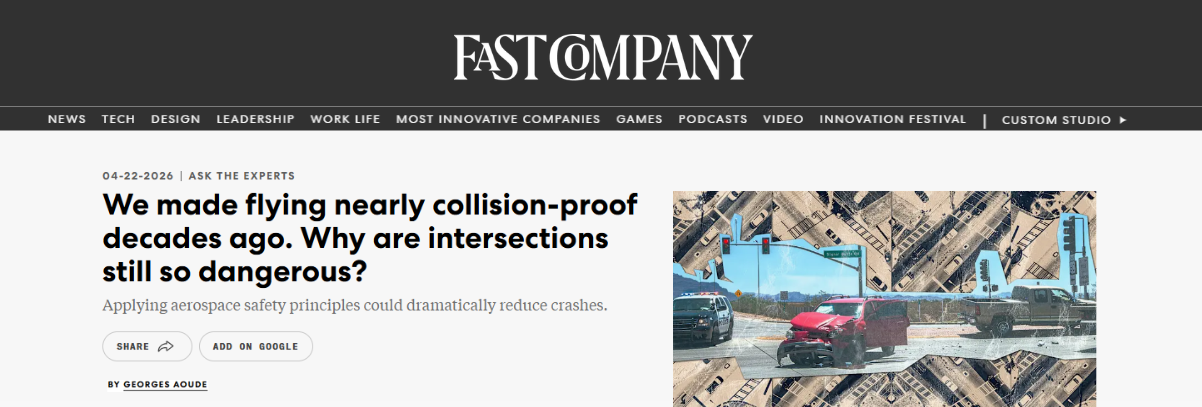
We made flying nearly collision-proof decades ago. Why are intersections still so dangerous?
April 22, 2026 — Fast Company — On average, 11 car crashes occur every minute in the U.S. By the time you finish reading this sentence, several vehicle collisions will have happened across the country, some of which were likely fatal.
In the world of aviation, the number of crashes involving a U.S. civilian aircraft is about 1,200 per year, and very few of those result in fatalities.
Despite the 5,500 American planes that are in the air at any given moment during peak times, collisions are rare, because airspace is designed for safety. Planes are required to communicate with one another and with ground control. No one gets to “opt out.” Our roads are another story. More than 280 million registered vehicles share U.S. streets with trucks, cyclists, and pedestrians—largely without any systemic communication. This isn’t a failure of drivers or technology, but a failure of system design.
By Dr. Georges Aoude
On average, 11 car crashes occur every minute in the U.S. By the time you finish reading this sentence, several vehicle collisions will have happened across the country, some of which were likely fatal.
In the world of aviation, the number of crashes involving a U.S. civilian aircraft is about 1,200 per year, and very few of those result in fatalities.
Despite the 5,500 American planes that are in the air at any given moment during peak times, collisions are rare, because airspace is designed for safety. Planes are required to communicate with one another and with ground control. No one gets to “opt out.”
Our roads are another story. More than 280 million registered vehicles share U.S. streets with trucks, cyclists, and pedestrians—largely without any systemic communication. This isn’t a failure of drivers or technology, but a failure of system design.
The real problem is infrastructure, not vehicle safety
Anyone who’s waited at a busy intersection understands how much uncertainty we accept as normal. Roadways are open systems with infinite variables—weather, pedestrians, distracted drivers, and aging infrastructure. Communication between vehicles is minimal, and infrastructure is largely silent—and in that gap lies the potential for deadly collisions.
When I was a child, I lost a close family member in a car crash. Sadly, that experience is not unique. Later in my career, that loss left me asking: why do we accept a level of loss on our streets that we would never tolerate in the skies?
The lesson from aerospace is clear: safety comes from mandatory communication and a shared system design, not from relying on each vehicle to figure it out on its own.
A shared safety layer must live in the physical and digital infrastructure itself. AI sensors and models need to be able to see our intersections and highways, understand how vehicles, pedestrians, and other road users interact, and predict risk before collisions occur.
Why aerospace is easier
In aerospace, safety is designed into the system from day one. During my research years at MIT, working on autonomous systems with NASA and the U.S. Navy, one thing was clear: no aircraft operates in isolation.
In both traditional air traffic control and newer systems designed to manage drones, safety isn’t something added later—it’s built on connectivity and constant information sharing. Aircraft continuously share their position and movement through standardized sensing and communication systems. Flight plans and operating rules allow ground systems to understand intent and predict where aircraft are headed next.
This creates a shared, real-time picture of the airspace. Humans and automated systems can spot conflicts early, coordinate decisions, and resolve risks long before paths intersect. That shared awareness is why near-misses in the air rarely turn into disasters.
Why infrastructure-first intelligence works
If we can engineer safety for aircraft moving at hundreds of miles per hour, we can do the same for streets moving at 30.
Most traffic systems today are built to react after something goes wrong. Predictive systems are designed to intervene before conflict turns into a crash. But for safety systems to work, intelligence must live in the environment itself—not just inside individual vehicles.
Roughly one quarter of crashes occur in intersections (which is unsurprising: we’ve all stood at intersections where everything looked calm until a car ran a red light or a cyclist swerved). These are prime locations for infrastructure-first intelligence.
An intelligent intersection works a lot like air traffic control on the ground. Sensors at signals and along the roadway detect what’s happening in real time, whether it’s a vehicle accelerating toward a red light, a pedestrian about to step off the curb, or a cyclist going the wrong way. Edge AI processes that information instantly, predicting potential conflicts. V2X communication, the digital equivalent of in-flight radios, then pushes alerts back out to road users, giving them time to react.
Essentially, it’s a loop: detection leads to prediction, which generates an alert and triggers an action, powered by continuously running AI models in the background.
The result isn’t perfect foresight, but a safety net that buys precious seconds. And on roads, seconds are what save lives.
We don’t need perfect tech to save lives today
Cities aren’t ignoring safety, but they often haven’t been given systems designed to manage it effectively. Those that have, have seen incredible results in a short period of time.
In Sarasota, Florida, a Smart City Initiative helped reduce crashes by 33 percent at targeted intersections in just one year by turning raw data into actionable insight. The technology gave city officials the clarity they needed to act quickly and deploy countermeasures where they mattered most.
The tools already exist. What’s missing is a willingness to treat intelligent intersections as infrastructure, not operational experiments. That means prioritizing high-crash corridors, requiring new signals to be V2X-ready, and investing in systems that deliver measurable outcomes.
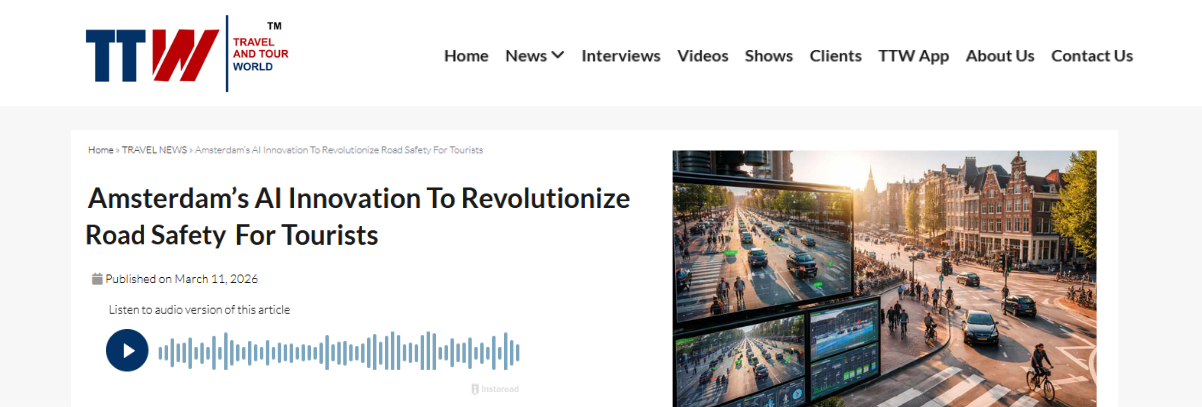
Amsterdam’s AI Innovation to Revolutionize Road Safety for Tourists
March 11, 2026 — Travel and World Tour — At the forefront of innovative traffic safety solutions, Amsterdam hosts the 2026 unveiling of Derq’s next-generation INSIGHT platform, setting a new standard for how cities worldwide can use AI to prevent fatalities at intersections. The company’s cutting-edge system empowers transportation agencies to transition from understanding past traffic incidents to actively preventing future risks.
The new release builds on Derq’s history of leveraging artificial intelligence to enhance road safety, enabling cities to shift their focus from reactive analysis to proactive decision-making. By analysing real-time data, the platform aims to provide actionable intelligence, helping transportation departments across the globe improve their traffic management and safety protocols.
With a powerful suite of agentic AI capabilities, Derq INSIGHT offers traffic authorities a versatile toolkit designed to identify patterns and pinpoint risk factors.
At the forefront of innovative traffic safety solutions, Amsterdam hosts the 2026 unveiling of Derq’s next-generation INSIGHT platform, setting a new standard for how cities worldwide can use AI to prevent fatalities at intersections. The company’s cutting-edge system empowers transportation agencies to transition from understanding past traffic incidents to actively preventing future risks.
The new release builds on Derq’s history of leveraging artificial intelligence to enhance road safety, enabling cities to shift their focus from reactive analysis to proactive decision-making. By analysing real-time data, the platform aims to provide actionable intelligence, helping transportation departments across the globe improve their traffic management and safety protocols.
AI and Data-Driven Tools Enhance Road Safety
With a powerful suite of agentic AI capabilities, Derq INSIGHT offers traffic authorities a versatile toolkit designed to identify patterns and pinpoint risk factors across urban roads. The platform’s enhanced algorithms provide deeper insights into near-miss occurrences, which are critical for understanding the underlying cause of accidents. By actively detecting fire hazards, wildlife presence, debris, and low-visibility conditions, the platform ensures a more comprehensive safety monitoring system.
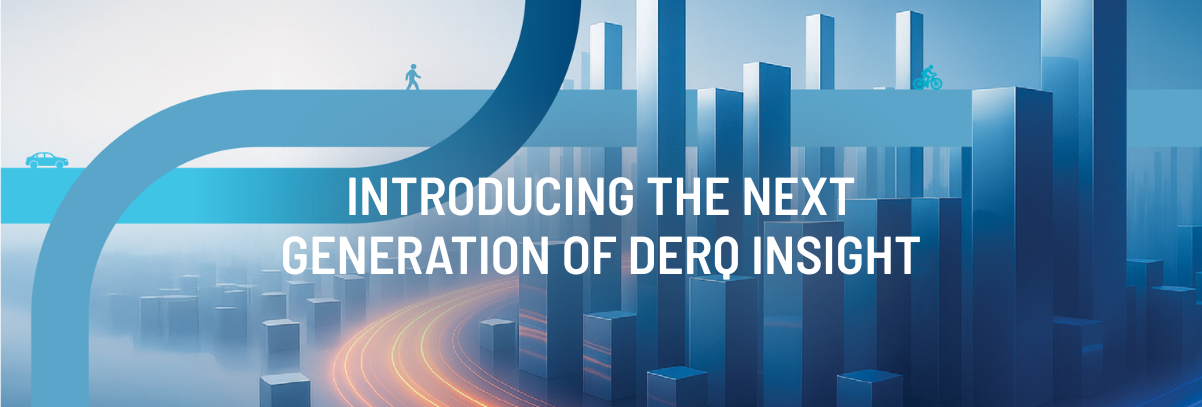
Derq Advances Traffic Safety Intelligence with Next Generation of INSIGHT, Unveiled at Intertraffic 2026
March 10, 2025 — Amsterdam, Netherlands — Derq, the intelligent transportation company enabling cities to prevent fatalities using proven, real-world AI at intersections, today announced the next generation of Derq INSIGHT, its real-time analytics and ATSPM platform. Unveiled at Intertraffic 2026 in Amsterdam, the new release equips agencies to shift from understanding what happened on the roads and why to taking action quickly and confidently to eliminate risk.
Since its founding in 2016, Derq has been a leader in AI-driven traffic safety, known for its accuracy in multimodal detection, predictive analytics, and near-miss analysis. The company has helped agencies analyze millions of near-misses and thousands of crashes to better understand roadway risk. The next generation of INSIGHT builds on that foundation to deliver a major leap forward in traffic and safety intelligence, moving beyond traditional analytics to proactive decision support.
March 10, 2026 — AMSTERDAM — Derq, the intelligent transportation company enabling cities to prevent fatalities using proven, real-world AI at intersections, today announced the next generation of Derq INSIGHT, its real-time analytics and ATSPM platform. Unveiled at Intertraffic 2026 in Amsterdam, the new release equips agencies to shift from understanding what happened on the roads and why to taking action quickly and confidently to eliminate risk.
Since its founding in 2016, Derq has been a leader in AI-driven traffic safety, known for its accuracy in multimodal detection, predictive analytics, and near-miss analysis. The company has helped agencies analyze millions of near-misses and thousands of crashes to better understand roadway risk. The next generation of INSIGHT builds on that foundation to deliver a major leap forward in traffic and safety intelligence, moving beyond traditional analytics to proactive decision support.
By identifying patterns, surfacing risk factors, and helping prioritize countermeasures, the platform enables traffic engineers and analysts to move faster—from passive monitoring to active prevention.
The 2026 release includes several agentic AI-powered capabilities:
Interactive agents to interpret data, compare timeframes, analyze reports, and identify trends and issues
Recommendation engine to proactively suggest countermeasures and mitigating actions for building safer, more efficient roadways
Enhanced near-miss analysis with an updated algorithm to provide root cause analysis and deeper insights
Automated Incident Detection (AID) to detect fire, wildlife, debris, and low-visibility conditions in real time
Expanded safety and traffic insights, including stop sign violations, queue spillovers, hard braking events, dilemma zone risks, and advanced ATSPMs
Live alerts and improved health monitoring to strengthen awareness and operational response
Versatile toolkit to empower agencies with customizable workflows, bespoke reporting, and flexible APIs
Reimagined user experience to deliver greater clarity, speed, and control
“Transportation agencies have no shortage of data, but turning that data into actionable intelligence has remained a major gap,” said Dr. Georges Aoude, co-founder and CEO of Derq. “The next frontier uses intelligence to understand why incidents occur, what drives traffic patterns, and how to respond in real time. With the next generation of INSIGHT, agencies can move from reactive analysis to proactive decision making.”
“Detroit has been using Derq INSIGHT for five years to better understand roadway safety risks, monitor safety trends, and guide data-driven improvements in high-risk corridors," said Tony Geara, Deputy Chief of Mobility Innovation for the City of Detroit. “We are encouraged by this continued innovation in traffic safety technology and look forward to exploring how these and other new capabilities can further support our City-wide efforts to increase roadway safety for all Detroiters.”
New capabilities will begin rolling out to all Derq customers in Q2 2026, with additional features released in phases throughout the year. This phased rollout ensures agencies can immediately begin benefiting from enhanced insights while continuing to gain access to new intelligence over time.
Transportation leaders can experience the next generation of Derq INSIGHT firsthand at Intertraffic 2026 in Amsterdam. To learn more or to schedule a demonstration, visit derq.com.
About Derq
Derq is an AI-powered intelligent transportation company helping cities and agencies and improve safety and optimize traffic flow for all road users. An MIT spinoff founded in 2016, Derq's award-winning technology is deployed across more than 40 agencies across the U.S., Canada, and the GCC region, with 20 patents and global recognition from leaders in AI and mobility. Visit https://en.derq.com/ to learn more.
Media Contact:
Flight PR
Alysha Light
media@derq.com
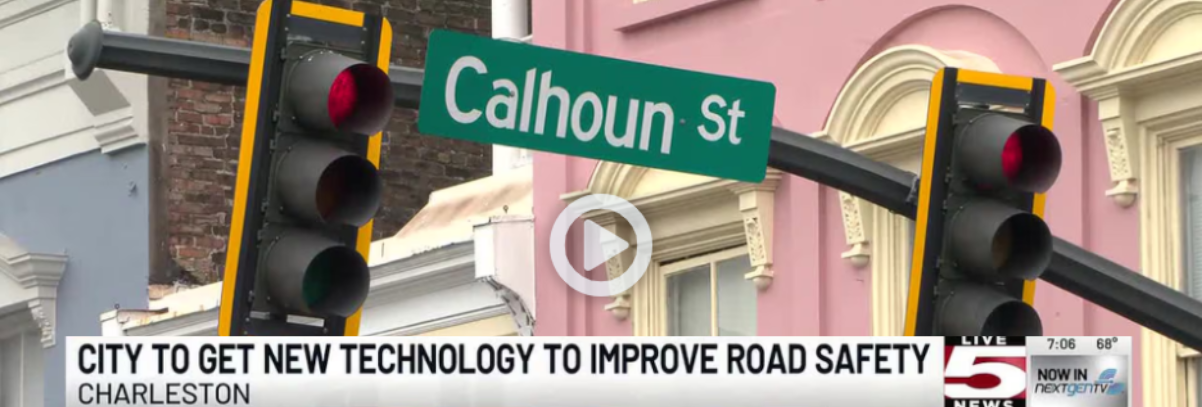
Charleston to upgrade Calhoun Street with AI technology for driver safety
February 19, 2026 — Charleston, SC — The City of Charleston will upgrade Calhoun Street with new technology focused on improving safety and reducing drive times for the estimated 20,000 cars that use the corridor daily.
The downtown street connects the peninsula from east to west and serves as a main thoroughfare for visitors and residents.
“Anybody that comes to the peninsula typically is going to go on Calhoun Street,” Mayor William Cogswell said.
Data shows that more than 700 crashes occurred on the corridor between 2013 and 2018.
“You know, this intersection is in a continuum of dangerous intersections,” Dr. David Cole, president of the Medical University of South Carolina, said.
February 19, 2026 — Charleston, SC — The City of Charleston will upgrade Calhoun Street with new technology focused on improving safety and reducing drive times for the estimated 20,000 cars that use the corridor daily.
The downtown street connects the peninsula from east to west and serves as a main thoroughfare for visitors and residents.
“Anybody that comes to the peninsula typically is going to go on Calhoun Street,” Mayor William Cogswell said.
Data shows that more than 700 crashes occurred on the corridor between 2013 and 2018.
“You know, this intersection is in a continuum of dangerous intersections,” Dr. David Cole, president of the Medical University of South Carolina, said.
Technology will monitor traffic in real time
The city plans to use artificial intelligence combined with traditional traffic management approaches to address safety concerns.
“Common sense with AI, combination,” Cogswell said.
The new technology will allow officials to monitor traffic conditions in real time and make adjustments to intersections as needed.
“Connected the ability to monitor in real time and then make adjustments to the intersection,” Lee White, deputy assistant secretary of the U.S. Department of Transportation, said.
Officials said they will analyze data to make both automated and manual adjustments to traffic patterns.
“Make adjustments both through algorithms, but you can also do it manually based on situations,” Cogswell said.
The upgrades will affect drivers as well as people who live, work and attend school in downtown Charleston, including those connected to MUSC.
“There’s more patients, more families, more students, everything within our campus,” Cole said.
The signals will respond dynamically to traffic demand to help reduce congestion, improve travel times, and minimize conflict points.
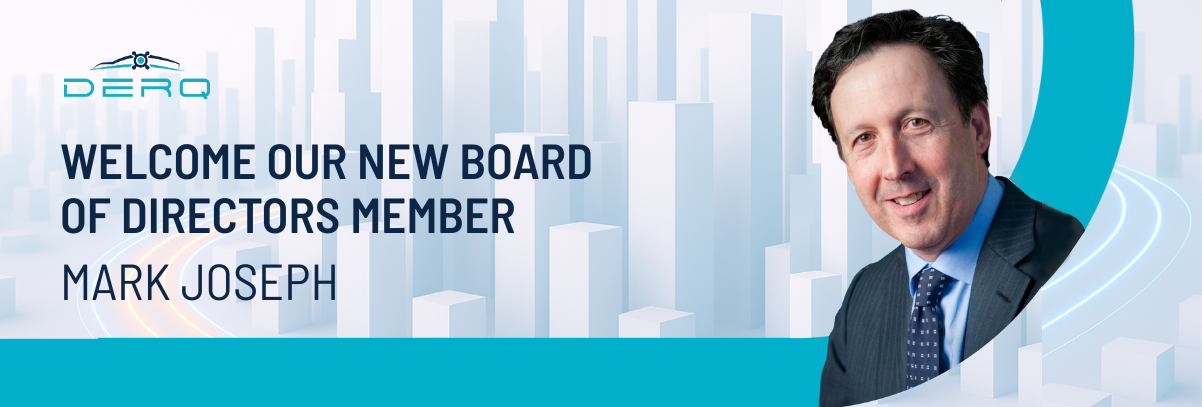
Derq Names Former Transdev North America CEO Mark Joseph to Board of Directors
December 9, 2025 — Detroit, MI — Derq, the MIT spinoff and AI-powered intelligent transportation company helping cities and agencies prevent crashes, improve safety for all road users, and optimize traffic flow, today announced the appointment of Mark Joseph to its Board of Directors.
A transportation and mobility industry leader with more than three decades of experience, Joseph currently serves as CEO of Mobitas Advisors, where he advises early- and mid-stage mobility companies and investors on growth strategy, operations, and regulatory engagement. Previously, as CEO of Veolia Transportation (now Transdev North America) and Global Chief Development Officer of Transdev Group, he grew the business to $1.5 billion in annual revenue and more than 20,000 employees across the U.S., Canada, the U.K., Ireland, and Latin America.
Mobility industry veteran brings deep expertise in scaling transportation innovation.
December 9, 2025 — DETROIT, MI — Derq, the MIT spinoff and AI-powered intelligent transportation company helping cities and agencies prevent crashes, improve safety for all road users, and optimize traffic flow, today announced the appointment of Mark Joseph to its Board of Directors.
A transportation and mobility industry leader with more than three decades of experience, Joseph currently serves as CEO of Mobitas Advisors, where he advises early- and mid-stage mobility companies and investors on growth strategy, operations, and regulatory engagement. Previously, as CEO of Veolia Transportation (now Transdev North America) and Global Chief Development Officer of Transdev Group, he grew the business to $1.5 billion in annual revenue and more than 20,000 employees across the U.S., Canada, the U.K., Ireland, and Latin America.
Throughout his career, Joseph has been instrumental in advancing innovative mobility solutions and fostering collaboration between the public and private sectors. His leadership has helped shape some of the world’s most successful transit operations and introduced cutting-edge technologies across multiple modes of transportation, from bus and rail to on-demand and autonomous services.
“Mark has been a valuable advisor to Derq from the start, consistently offering thoughtful guidance rooted in decades of mobility leadership, said Dr. Georges Aoude, CEO and Co-founder of Derq. “I’m excited to have his voice at the Board table as we enter this next stage of growth. His experience scaling transportation companies will help us strengthen partnerships and expand our solutions with cities and agencies across the world.”
Joseph added: “As a longtime fleet operator, safety has always been core to my work, and Derq is delivering the kind of technology that can meaningfully reduce and ultimately prevent crashes. Derq has made impressive progress, pairing industry-leading technology with disciplined execution. As a result, the team has attracted terrific clients, partners, and investors, including AT&T and e&. Joining the Board is an opportunity to help scale a solution I believe can reshape how cities protect road users.”
Visit https://en.derq.com/ for more information.
About Derq
Derq is an AI-powered intelligent transportation company helping cities and agencies and improve safety and optimize traffic flow for all road users. An MIT spinoff founded in 2016, Derq's award-winning technology is deployed across more than 40 agencies across the U.S., Canada, and the GCC region, with 20 patents and global recognition from leaders in AI and mobility. Visit https://en.derq.com/ to learn more.
Media Contact:
Flight PR
Alysha Light
media@derq.com

Derq Names Former Caltrans Director Randy Iwasaki to Advisory Board
November 19, 2025 — Walnut Creek, CA — Derq, an award-winning, AI-powered road safety and traffic solutions company, today announced the appointment of Randell (Randy) Iwasaki to its advisory board.
A nationally recognized leader in intelligent transportation systems and infrastructure innovation, Iwasaki currently serves as President and CEO of Iwasaki Consulting Services, where he advises public agencies and technology companies on transportation strategy and smart mobility. Previously, he was Executive Director of the Contra Costa Transportation Authority (CCTA) and Director of the California Department of Transportation (Caltrans), overseeing more than 50,000 lane miles of state highway and a $14 billion annual budget.
Transportation innovator Iwasaki brings decades of leadership across infrastructure, policy, and intelligent transportation systems.
November 19, 2025 — WALNUT CREEK, CA — Derq, an award-winning, AI-powered road safety and traffic solutions company, today announced the appointment of Randell (Randy) Iwasaki to its advisory board.
A nationally recognized leader in intelligent transportation systems and infrastructure innovation, Iwasaki currently serves as President and CEO of Iwasaki Consulting Services, where he advises public agencies and technology companies on transportation strategy and smart mobility. Previously, he was Executive Director of the Contra Costa Transportation Authority (CCTA) and Director of the California Department of Transportation (Caltrans), overseeing more than 50,000 lane miles of state highway and a $14 billion annual budget.
At CCTA, Iwasaki founded GoMemtum Station, one of the nation’s largest secure proving grounds for testing connected and automated vehicles. His leadership in deploying emerging technologies, building public-private partnerships, and shaping transportation policy has influenced infrastructure innovation across the U.S. and internationally.
“Randy’s decision to join Derq is a strong endorsement of our technology,” said Dr. Georges Aoude, CEO and co-founder of Derq. “He recognizes that our AI platform is ahead of the market and that many of the agencies he has engaged with throughout his career stand to benefit from our advanced ITS solutions. Randy’s expertise and relationships across the transportation ecosystem will be instrumental as we expand our deployments in California and across the U.S.”
Derq’s AI-powered technology is live across 17 U.S. states and Canada, with several projects underway in California, including Fremont and Caltrans District 12.
“Derq is delivering the type of high-performing, deployable technology that agencies have been seeking; solutions that improve safety and mobility today while building the foundation for future connected and automated systems,” said Iwasaki. “I’m excited to support Derq’s continued growth and help bring this technology to more communities.”
The appointment follows the recent news of Ty Beltramo joining Derq as Chief Technology Officer, underscoring the company’s continued investment in world-class leadership to accelerate its growth globally.
Visit https://en.derq.com/ for more information.
About Derq
Derq is an AI-powered intelligent transportation company helping cities and agencies and improve safety and optimize traffic flow for all road users. An MIT spinoff founded in 2016, Derq's award-winning technology is deployed across more than 40 agencies across the U.S., Canada, and the GCC region, with 20 patents and global recognition from leaders in AI and mobility. Visit https://en.derq.com/ to learn more.
Media Contact:
Flight PR
Alysha Light
media@derq.com
Sarasota 2.0: The City’s Quiet Tech Transformation
October 13, 2025 — Sarasota, FL — From Wi-Fi benches to bayfront sensors and AI-powered traffic lights, Sarasota is weaving technology into its everyday beauty, one subtle upgrade at a time.
Downtown Sarasota looks as charming as ever, with the sea breeze, the art, and the quiet hum of local life. But beneath that easy rhythm, the city is quietly getting smarter. From Wi-Fi benches to bayfront sensors and AI-powered traffic lights, Sarasota is weaving technology into its everyday beauty, one subtle upgrade at a time.
Sarasota has always sold sunshine and sophistication, but the past few years have been so full of technology that even that seduction runs on Wi-Fi signals and touchscreen taps. The city has discreetly moved to a digitally connected community, where technology blends with day-to-day living rather than competing with each other.
October 13, 2025 — SARASOTA, Florida — From Wi-Fi benches to bayfront sensors and AI-powered traffic lights, Sarasota is weaving technology into its everyday beauty, one subtle upgrade at a time.
Downtown Sarasota looks as charming as ever, with the sea breeze, the art, and the quiet hum of local life. But beneath that easy rhythm, the city is quietly getting smarter. From Wi-Fi benches to bayfront sensors and AI-powered traffic lights, Sarasota is weaving technology into its everyday beauty, one subtle upgrade at a time.
From Charm to Connectivity
Sarasota has always sold sunshine and sophistication, but the past few years have been so full of technology that even that seduction runs on Wi-Fi signals and touchscreen taps. The city has discreetly moved to a digitally connected community, where technology blends with day-to-day living rather than competing with each other.
Civic engagement occurs just as easily. Through SeeClickFix, citizens report maintenance issues in seconds, and Alert Sarasota sends text messages on storms and closures. Residents are planning weekends with Yelp, reserving restaurant tables with OpenTable, and purchasing event tickets with Eventbrite.
Any everyday interaction now passes through a web of digital tools. Homebuyers search Matterport 3D tours, paddlers use TideCharts to survey the body of water before heading out, and small retailers use Square and Shopify to accept payments seamlessly.
Meanwhile, Sarasota’s concept of entertainment has gone digital. From Louisiana to Florida, Gulf Coast cities are experiencing similar new habits: streaming shows, participating in virtual events, and using real-time platforms to bring music, games (iGames included), and culture to their screens. For instance, Louisiana real money games are popular all over the Gulf. They are mostly popular because the region’s easy access to online casino platforms, fast connections, and quick digital payments make modern entertainment just a tap away.
While residents experience changes like faster Wi-Fi and smarter crosswalks, the city at large is operating with a clear game plan, unofficially called the Sarasota 2.0 Agenda, a long-range digital modernization plan initiated under the city’s larger Smart City initiative.
The goal of Sarasota 2.0 is to create a connected coastal city that uses technology to make it safer, more sustainable, and more efficient, all while preserving its neighborhood feel.
The framework is based on five major priorities:
Smart Infrastructure - Upgrading traffic signals, lighting, and utilities that can communicate via real-time data systems.
Environmental Intelligence - Using sensors and analytics to monitor sea level, water quality, and red-tide activity to help the city adapt more quickly to climate change.
Digital Equity & Access - Increasing Wi-Fi and broadband access so that all Lido Key-to-Newtown residents have affordable and reliable access to the internet.
Data Transparency - developing open dashboards so citizens can understand how decisions are made and what the city is measuring;
Civic Innovation - Working with universities, start-ups, and local organizations to pilot projects before they can be scaled city-wide.
AI Patroling the Streets (In a Good Way)
One of the more visible improvements is the AI-powered traffic monitoring. Near-miss detection and risky crossings are detected at 16 intersections in and around downtown using cameras. The data allows signal timing to be optimized and safety to be increased without increasing police presence.
City engineers describe it as part of their “Target Zero” goal, aiming to eliminate serious crashes and injuries. The technology does not capture faces or license plates; rather, it identifies patterns.
Engineers can determine if a crosswalk is confusing or if a left-turn lane is causing jams, and fix it before a crash occurs. For people who live in it, the difference is quiet, with fewer horn blowings, less waiting, and safer walks to get dinner:
Wi-Fi, Fibre, and the Invisible Backbone
Sarasota has made investments in fiber infrastructure that will support emergency services, bright lighting, and the next generation of municipal systems. For residents, the payoff can be seen in free Wi-Fi in the city’s parks and the ability to handle faster broadband rollouts.
In an area where many people combine working from home, online learning, and streaming culture, this foundation is significant. Freelancers, small studios, and remote employees have called the city’s upgraded network “quite revolutionary”; it allows them to live the beach life without compromising on bandwidth. Tech Leaders at Home:
Digital Entrepreneurs in Sarasota.
It is not just government systems getting smarter. Local firms such as TENEX.ai, a Sarasota cybersecurity company that recently raised $27 million in funding, reflect the area’s increasing tech confidence.
Hybrid teams of apps, analytics, and clean-tech startups are working in local co-working spaces downtown, innocently plugging into the same digital networks that are improving public life. “The combination of civic infrastructure and private innovation puts Sarasota in a position unlike any other: a city small enough to be nimble, but connected enough to be able to compete anywhere in the world.”
The Balancing Act
As with all new technology, some embrace it, while others do not. Residents are rightfully skeptical of privacy and data access. They need to know that improvements are being made in response to these concerns in every community, not just downtown.
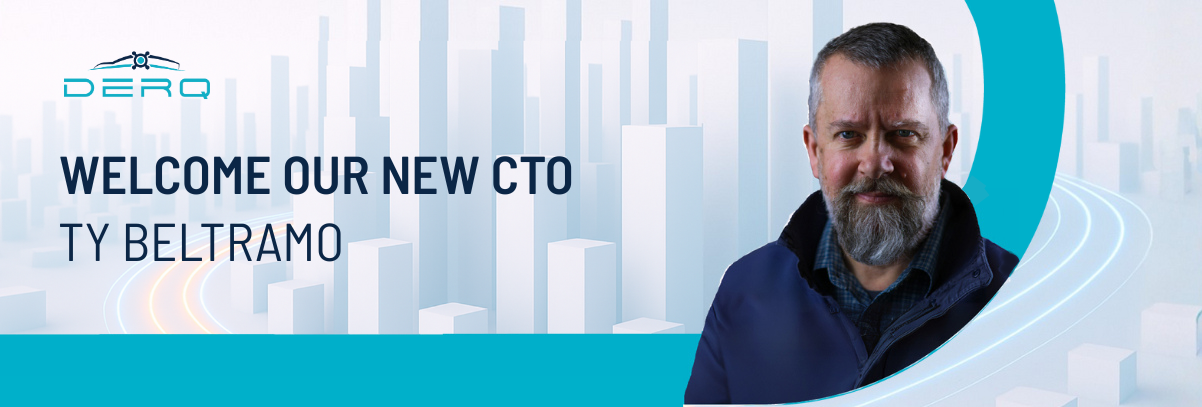
Derq Appoints Former GM OnStar Chief Architect Ty Beltramo as Chief Technology Officer
October 7, 2025 — Detroit, MI — Derq, the MIT spinoff transforming road safety through artificial intelligence, today announced the appointment of Ty Beltramo as Chief Technology Officer to drive the next phase of AI-powered road safety. Beltramo succeeds co-founder Amer Abufadel, who moves to a senior advisor role after leading the company’s technology development since its founding in 2016.
Beltramo joins Derq at a pivotal time as the company accelerates deployment of its AI platform across more than 40 agencies in the United States, Canada, and the GCC region. As CTO, he will lead Derq’s technology strategy and engineering teams, with a focus on scaling AI systems that enable cities to prevent crashes and optimize traffic flow in real-time.
Beltramo succeeds founding CTO Amer Abufadel, who transitions to senior advisor.
October 7, 2025 — DETROIT, MI — Derq, the MIT spinoff transforming road safety through artificial intelligence, today announced the appointment of Ty Beltramo as Chief Technology Officer to drive the next phase of AI-powered road safety. Beltramo succeeds co-founder Amer Abufadel, who moves to a senior advisor role after leading the company’s technology development since its founding in 2016.
Beltramo joins Derq at a pivotal time as the company accelerates deployment of its AI platform across more than 40 agencies in the United States, Canada, and the GCC region. As CTO, he will lead Derq’s technology strategy and engineering teams, with a focus on scaling AI systems that enable cities to prevent crashes and optimize traffic flow in real-time.
Beltramo brings more than 25 years leading technology transformations that transportation agencies are now navigating. As chief architect at General Motors' OnStar, he transformed the solution from an aftermarket add-on to factory-installed technology, scaling from 30,000 to 3 million users in three years. As CTO of MapQuest, he modernized infrastructure and launched 20 products across navigation and data services. Most recently, as a Fellow at CGS Advisors, he advised fintech and consumer electronics clients on deploying agentic AI systems for complex, regulated workflows and developed an enterprise architecture for an EV startup.
“Ty’s hands-on technical expertise and proven record of scaling mission-critical systems will help us bring AI-powered road safety to scale worldwide,” said Dr. Georges Aoude, CEO and co-founder of Derq. “Amer’s leadership has been foundational in building our technology, and we’re grateful for his continued guidance as we move into this next chapter.”
Derq’s hardware-agnostic AI technology seamlessly integrates with existing infrastructure to detect, classify, and predict road user behavior in real-time. Its flagship products, Derq SENSE and Derq INSIGHT, help cities reduce crashes and improve mobility without costly infrastructure overhauls. In Sarasota, Florida, the company’s technology helped reduce crashes by 33% year-over-year, including a 90% reduction at one intersection—results certified by the Florida Department of Transportation.
“From my early days at OnStar, safety has been a through-line in my career,” said Beltramo. “What excites me about Derq is the ability to combine spatial data, systems thinking, and advanced AI to prevent crashes before they happen. This is about scaling safety for every road user, everywhere.”
Derq’s platform transforms raw data into actionable insights, identifying safety hotspots, generating V2X messages, and optimizing traffic signals to prevent collisions. Protected by 18 issued patents, the platform has earned global recognition from leaders in AI and mobility.
Visit https://en.derq.com/ for more information.
About Derq
Derq is an AI-powered intelligent transportation company helping cities and agencies prevent crashes, solve complex road safety challenges, and improve traffic flow. An MIT spinoff founded in 2016, Derq's award-winning technology is deployed across more than 40 agencies across the U.S., Canada, and the GCC region, with 18 patents and global recognition from leaders in AI and mobility. Visit https://en.derq.com/ to learn more.
Media Contact:
Flight PR
Alysha Light
media@derq.com

Derq and Modern Network Enterprises Announce Partnership to Advance Road Safety and Smart Mobility in the Sultanate of Oman
September 17, 2025 — Muscat, Oman — Derq, an award-winning AI-powered road safety and traffic solutions company, today announced a new partnership with Modern Network Enterprises (MNE), a leading provider of intelligent traffic solutions in the Sultanate of Oman. The collaboration marks Derq’s strategic expansion into the Sultanate and establishes a framework for deploying next-generation intelligent transportation systems nationwide.
Together, Derq and MNE will focus on immediate opportunities to demonstrate the impact of AI-powered mobility technologies in Oman, while building a foundation for long-term deployment. The companies will work with public and private stakeholders to accelerate the adoption of intelligent transportation systems across the Sultanate.
Announced during COMEX 2025, the strategic partnership expands Derq’s presence in the Sultanate and supports Oman’s Vision 2040 initiatives.
September 9, 2025 — MUSCAT, Oman — Derq, an award-winning AI-powered road safety and traffic solutions company, today announced a new partnership with Modern Network Enterprises (MNE), a leading provider of intelligent traffic solutions in the Sultanate of Oman. The collaboration marks Derq’s strategic expansion into the Sultanate and establishes a framework for deploying next-generation intelligent transportation systems nationwide.
The partnership underscores Derq’s ongoing moves to expand its presence in the Gulf region and aligns with Oman’s Vision 2040 smart city initiatives. By joining forces with MNE, Derq will accelerate the rollout of AI-powered solutions designed to improve road safety, reduce congestion, and enhance the overall mobility experience for road users.
“Oman is at a pivotal moment in shaping the future of its cities and mobility systems. By combining Derq’s state-of-the-art AI platform with MNE’s local ITS expertise and strong network, we have a real opportunity to reduce crashes, ease congestion, and set a new standard for road safety in the region,” said Dr. Georges Aoude, CEO and co-founder of Derq.
Together, Derq and MNE will focus on immediate opportunities to demonstrate the impact of AI-powered mobility technologies in Oman, while building a foundation for long-term deployment. The companies will work with public and private stakeholders to accelerate the adoption of intelligent transportation systems across the Sultanate.
“Working with Derq lets us bring world-class AI mobility and smart city solutions to Oman in a way that reflects our national priorities,” said Tariq Alfarsi, CEO, Modern Network Enterprises. ”This collaboration strengthens Oman’s leadership in smart transportation while delivering tangible safety and efficiency benefits to our communities.”
Visit https://en.derq.com/ for more information.
About Derq
Derq is an AI-powered intelligent transportation company helping cities and agencies prevent crashes, solve complex road safety challenges, and improve traffic flow. An MIT spinoff founded in 2016, Derq's award-winning technology is deployed across more than 40 agencies across the U.S., Canada, and the GCC region, with 18 patents and global recognition from leaders in AI and mobility. Visit https://en.derq.com/ to learn more.
Modern Network Enterprises
Modern Network Enterprises, a subsidiary of Tadoom established in 2004, has emerged as a trusted provider of innovative Smart City, Traffic, and Street Lighting solutions, offering reliable and client-focused systems tailored to diverse urban needs.
Over the years, the company has consistently developed and expanded, investing in cutting-edge technology and leveraging the dedication and expertise of management and professionals. Its growth has been strategically executed to maintain high standards and to ensure an unwavering commitment to high-quality equipment and exceptional customer service.
Today, Modern Network Enterprises stands as a pioneer in delivering state-of-the-art traffic management, street lighting solutions, and smart city platforms, demonstrating remarkable growth and industry leadership. Visit https://www.mne.om/ to learn more.
Media Contact:
Flight PR
Alysha Light
media@derq.com
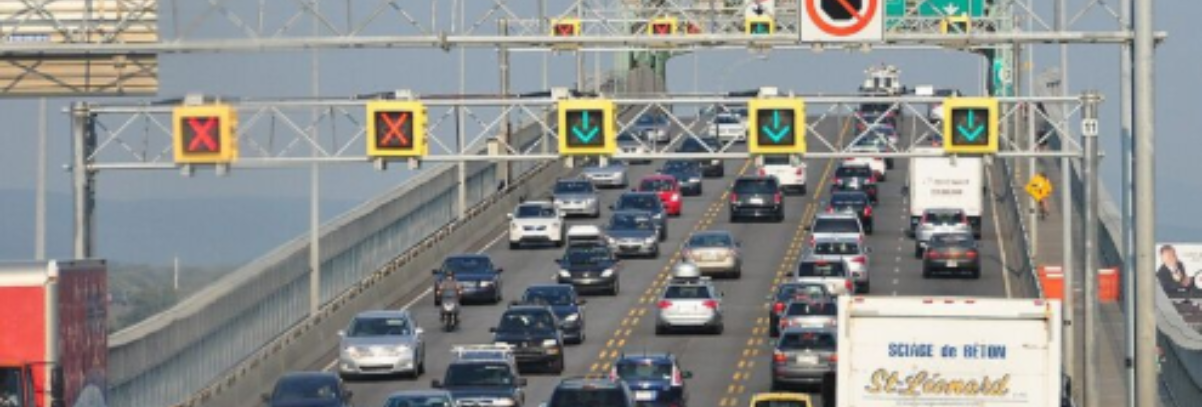
Derq expands AI traffic safety across Canada
September 15, 2025 — Canada — MIT spin-off Derq is partnering Tacel to expand availability of its AI-powered traffic safety and connected vehicle technology across Canada. The collaboration will accelerate deployment of Derq’s AI technology across Canadian cities. Tacel has a 46-year track record serving transportation agencies across the country.
Through the partnership, Canadian municipalities and transportation agencies will gain easier access to Derq’s ITS platform. This includes next-gen traffic detection, real-time safety insights, traffic performance monitoring, and V2X connected vehicle applications. Each is designed to detect in harsh conditions, analyse safety events, optimise traffic flow, prevent crashes before they happen, and protect vulnerable road users.
September 15, 2025 — Canada — MIT spin-off Derq is partnering Tacel to expand availability of its AI-powered traffic safety and connected vehicle technology across Canada. The collaboration will accelerate deployment of Derq’s AI technology across Canadian cities. Tacel has a 46-year track record serving transportation agencies across the country.
Through the partnership, Canadian municipalities and transportation agencies will gain easier access to Derq’s ITS platform. This includes next-gen traffic detection, real-time safety insights, traffic performance monitoring, and V2X connected vehicle applications. Each is designed to detect in harsh conditions, analyse safety events, optimise traffic flow, prevent crashes before they happen, and protect vulnerable road users.
“Partnering with Tacel lets us bring our award-winning AI safety solutions to Canadian cities efficiently and effectively, building on deployments that have reduced crashes by more than 30% in other markets,” said Karl Jeanbart, COO and co-founder
“Canada represents a significant growth opportunity as cities nationwide pursue ambitious road safety and traffic efficiency goals while preparing for the future of connected and autonomous mobility,” said Karl Jeanbart, COO and co-founder of Derq. “Partnering with Tacel lets us bring our award-winning AI solutions to Canadian cities efficiently and effectively, building on deployments that have helped reduce crashes by more than 30% in other markets.”

Derq Partners with Tacel Ltd. to Expand AI Traffic Safety Solutions Across Canada
September 10, 2025 — Montréal, Canada — Derq, the MIT spin-off and leader in AI-powered traffic safety and connected vehicle technology, today announced a strategic distribution partnership with Tacel Ltd., Canada’s leading provider of intelligent transportation systems. The collaboration will accelerate deployment of Derq’s proven AI technology across Canadian municipalities, leveraging Tacel’s 46-year track record serving transportation agencies nationwide.
Through the partnership, Canadian municipalities and transportation agencies will gain easier access to Derq’s cutting-edge ITS platform–including next-gen traffic detection, real-time safety insights, traffic performance monitoring, and V2X connected vehicle applications–each designed to detect in harsh conditions, analyze safety events, optimize traffic flow, prevent crashes before they happen, and protect vulnerable road users.
ITS leader to deliver Derq’s proven AI road safety solutions nationwide, advancing Vision Zero goals across Canada.
September 10, 2025 — MONTREAL, Canada — Derq, the MIT spin-off and leader in AI-powered traffic safety and connected vehicle technology, today announced a strategic distribution partnership with Tacel Ltd., Canada’s leading provider of intelligent transportation systems. The collaboration will accelerate deployment of Derq’s proven AI technology across Canadian municipalities, leveraging Tacel’s 46-year track record serving transportation agencies nationwide.
Through the partnership, Canadian municipalities and transportation agencies will gain easier access to Derq’s cutting-edge ITS platform–including next-gen traffic detection, real-time safety insights, traffic performance monitoring, and V2X connected vehicle applications–each designed to detect in harsh conditions, analyze safety events, optimize traffic flow, prevent crashes before they happen, and protect vulnerable road users.
This milestone expands Derq’s North American presence with scalable, AI-powered ITS systems that integrate with cities’ existing infrastructure and have been proven to reduce crashes by 33%.
“Canada represents a significant growth opportunity as cities nationwide pursue ambitious road safety and traffic efficiency goals while preparing for the future of connected and autonomous mobility,” said Karl Jeanbart, COO and co-founder of Derq. “Partnering with Tacel lets us bring our award-winning AI solutions to Canadian cities efficiently and effectively, building on deployments that have helped reduce crashes by more than 30% in other markets.”
The move coincides with Derq’s participation at ITS Canada Technology Innovation Forum in Montreal, where Jeanbart will lead a talk on “Large-Scale AI Analysis: The Montreal Model for Safer and Smarter Cities.”
“Derq's technology directly aligns with our mission to provide Canadian communities with innovative solutions for modern traffic challenges,” said Yassine Benamghar, Vice President at Tacel. “Their proven ability to help reduce crashes will help our municipal partners achieve measurable progress toward their road safety objectives.”
For more information, visit https://en.derq.com/.
About Derq
Derq is an AI-powered intelligent transportation company helping cities and agencies prevent crashes, solve complex road safety challenges, and improve traffic flow. An MIT spinoff founded in 2016, Derq's award-winning technology is deployed across more than 40 agencies across the U.S., Canada, and the GCC region, with 18 patents and global recognition from leaders in AI and mobility. Visit https://en.derq.com/ to learn more.
About Tacel Ltd.
Founded in 1979, Tacel Ltd. is Canada’s trusted provider of intelligent transportation systems and traffic signal solutions. With over 46 years of expertise, Tacel partners with municipalities and transportation agencies nationwide to deliver reliable, innovative, and sustainable products that enhance road safety and optimize mobility. From traffic signal equipment to advanced connected solutions, Tacel is committed to building smarter, safer communities across Canada.
Learn more at www.tacel.ca.
Media Contact:
Flight PR
Alysha Light
media@derq.com
Derq s’associe à Tacel Ltd. pour déployer ses solutions d’IA pour la sécurité routière à travers le Canada
Leader des STI, Tacel livrera les solutions d’IA reconnues de Derq partout au pays, faisant progresser les objectifs de Vision Zéro au Canada.
MONTRÉAL — 10 septembre 2025 — Derq, startup issue du MIT et chef de file des technologies propulsées par l’IA de sécurité routière et de véhicules connectés, annonce aujourd’hui un partenariat de distribution stratégique avec Tacel Ltd., principal fournisseur canadien de systèmes de transport intelligents (STI). Cette collaboration vise à accélérer le déploiement de la technologie d’IA reconnue de Derq dans les municipalités canadiennes, en s’appuyant sur les 46 années d’expérience de Tacel au service des organismes de transport à l’échelle du pays.
Ce partenariat permettra aux municipalités et organismes de transport du Canada d'accéder plus facilement à la plateforme STI de pointe de Derq, qui inclut la détection de nouvelle génération, des analyses de sécurité routière en temps réel, le suivi de la performance de la circulation et des applications V2X pour véhicules connectés. Ces solutions sont conçues pour fonctionner dans des conditions difficiles, analyser les incidents de sécurité, optimiser les flux de circulation, prévenir les collisions et protéger les usagers vulnérables.
Cette étape renforce la présence nord-américaine de Derq avec des systèmes STI extensibles propulsés par l’IA, qui s’intègrent à l’infrastructure existante des villes et ont démontré des réductions de collisions allant jusqu'à 33 %.
« Le Canada représente un important potentiel de croissance alors que les villes du pays poursuivent des objectifs ambitieux en matière de sécurité routière et de contrôle de la circulation, tout en se préparant à l’avenir de la mobilité connectée et autonome, » a déclaré Karl Jeanbart, chef de l’exploitation et cofondateur de Derq. « En nous associant à Tacel, nous pouvons offrir rapidement et efficacement nos solutions reconnues d’IA aux villes canadiennes, en nous appuyant sur des déploiements qui ont contribué à réduire les collisions de plus de 30 % dans d’autres marchés. »
Cette annonce coïncide avec la participation de Derq au Forum d'innovation technologique de STI Canada à Montréal, où M. Jeanbart animera une conférence intitulée : Analyse à grande échelle par IA : le modèle montréalais pour des villes plus sûres et plus intelligentes.
« La technologie de Derq s’aligne directement avec notre mission: fournir aux collectivités canadiennes des solutions innovantes aux défis modernes de la circulation, » a déclaré Yassine Benamghar, vice-président chez Tacel. « Leur capacité démontrée à aider à réduire les collisions permettra à nos partenaires municipaux de réaliser des progrès mesurables vers leurs objectifs de sécurité routière. »
Pour en savoir plus : https://en.derq.com/.
À propos de Derq
Derq est une entreprise de systèmes de transport intelligent propulsés par l’IA qui aide les villes et les organismes à prévenir les collisions, à résoudre des enjeux complexes de sécurité routière et à améliorer la circulation. Startup issue du MIT fondée en 2016, la technologie primée de Derq est déployée dans plus de 40 organismes de transport aux États-Unis, au Canada et dans la région du Golfe (CCG), avec 18 brevets et une reconnaissance mondiale de leaders de l’IA et de la mobilité. Visitez https://en.derq.com/ pour en savoir plus.
À propos de Tacel Ltd.
Fondée en 1979, Tacel Ltd. est un fournisseur de confiance au Canada de systèmes de transport intelligents et de solutions de feux de circulation. Forte de plus de 46 ans d’expertise, Tacel collabore avec des municipalités et des organismes de transport partout au pays afin d’offrir des produits fiables, innovants et durables qui améliorent la sécurité routière et optimisent la mobilité. Des équipements de signalisation aux solutions connectées avancées, Tacel s’engage à bâtir des collectivités plus intelligentes et sécuritaires au Canada. En savoir plus : www.tacel.ca
Relations médias
Flight PR
Alysha Light
media@derq.com